geloven – to believe.
het geloof – faith, belief, trust
Je kunt me geloven of niet – believe it or not
Niet te geloven! – unbelievable!
geloven – to believe.
het geloof – faith, belief, trust
Je kunt me geloven of niet – believe it or not
Niet te geloven! – unbelievable!
SINGULAR (stressed, unstressed):
1st person: mijn, (m’n) – my
2nd person: jouw, je – your
2nd p. formal: uw – your
3rd person: zijn, (z’n) – his/its
3rd person: haar, (d’r) – her
PLURAL (stressed, unstressed):
1st person: ons/onze – our
2nd person: jullie, je – your
2nd p. formal: uw – your
3rd person: hun, (d’r) – their
Ons is used before neuter singular nouns:
Dat is ons huis.
Onze is used before plural neuter nouns and common nouns:
Dit zijn onze boeken.
Dit is onze poes.
Dit zijn onze poezen.
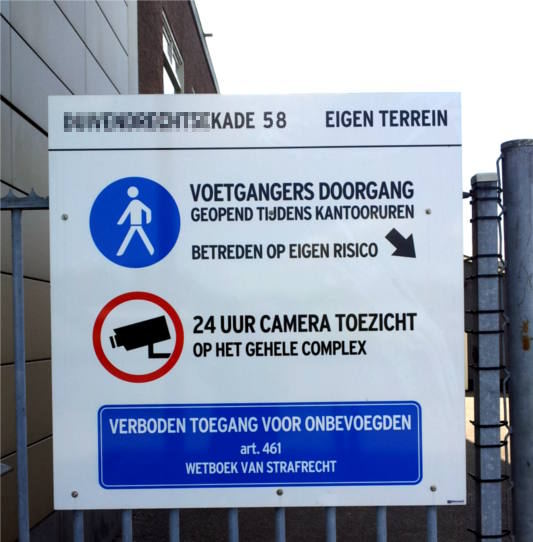
Eigen terrein
Private territory
—
Voetganger doorgang
geopend tijdens kantooruren
Entrance is opened for pedestrians during the working/business hours
—
betreden op eigen risico
Entrance is on your own risk / Enter on your own risk
—
24 uur camera toezicht
op het gehele complex
24-hour camera supervision in the entire complex
—
Verboden toegang voor onbevoegden
art. 461 wetboek van strafrecht
Entrance is forbidden for the unauthorized. Article 461, book of criminal law.
de kade – embankment, quay, wharf
eigen – own, private, personal
het terrein – territory, terrain, ground(s)
de voetganger – pedestrian
de doorgang – 1. passage, way through 2. occurrence
tijdens – during
het uur(plural: uren) – hour, period.
openen – to open, to begin, to start
betreden – to enter
de risico – risk
zicht – sight, view
het toezicht – supervision, oversee
geheel – whole, entire
verboden – forbidden
de toegang – entrance, entry, access
onbevoegd – unauthorized, unqualified
bevoegd – authorized, competent, qualified
art. – het artikel – article, section, clause
de wet – law, rule
strafrecht – criminal law, criminal justice
de straf – punishment, penalty
het recht – justice, law, right
A few pictures of the building windows combined together. Taken in Rotterdam, in July 2012.
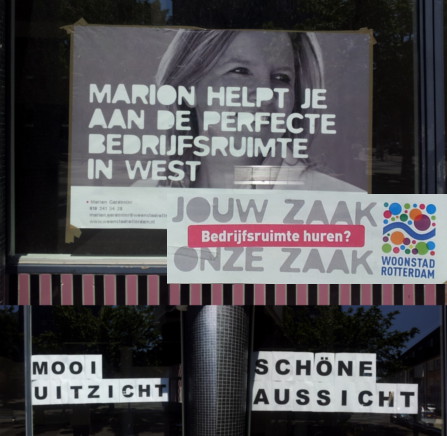
Marion helpt je aan de perfecte bedrijfsruimte in west.
Marion helpt je aan de perfecte bedrijfsruimte in west.
Marion helps you with the perfect business premises (commercial property?) in west.
huren – to rent
zaak – 1. thing 2. business, matter, affair
bedrijf – 1. business, company, enterprise, firm 2. act, operation
ruimte – room, space
mooi uitzicht – beautiful view
German “aussicht” (on the right) and Dutch “uitzicht” (on the left) are really similar.
binnenkort – soon, shortly
daarna – afterwards
de doos – box
het eind – end
hard – hard, fast, loud
heel/hele – whole
het huiswerk – homework
iets – something, anything
de juf – teacher, Miss.
kloppen – to knock, to be right, to be correct
oma – grandma
ontmoeten – meet
opa – grandpa
over – about (after verbs like praten)
de rekenles – arithmetic lesson
de stapel – pile
uitstekend – excellent
vertellen – to tell (, to say)
zeggen – to say
hopen – to hope
praten – to talk
koken – to cook
missen – to miss
blaffen – to bark
kuchen – to cough
bouwen – to build
horen – to hear
bellen – to ring
branden – to burn
bedoelen – to mean
bepraten – to discuss
geloven – to believe
verbranden – to burn down
verhuizen – to move (house), to relocate
al – already
dragen – to carry
geloven – believe, think
het loket – ticket office, ticket window
het spoor – track
spoor vijf – platform five
vaak – often
vergeten – to forget
vertrekken – to depart, to leave
de broer – brother
de dochter – daughter
haast hebben – to be in a hurry
de ingang – entrance
de kaart – ticket
klaar – 1. ready 2. clear 3.pure.
het kwartier – quarter (of an hour)
nodig hebben – to need
over – over, above, in
het pakje – packet, package
het perron – platform
het retourtje – return ticket
de sigaret – cigarette
de tas – bag
volgens – according to
de wc – lavatory, wc
de zoon – son
zwaar – heavy
SINGULAR (stressed, unstressed)
1st person: mij, me – me
2nd person: jou, je – you
2nd p. (formal) u – you
3rd person: hem, (‘m) – him
3rd person: haar, (d’r) – her
3rd person: het, (‘t) – it
PLURAL (stressed, unstressed)
1st person: ons – us
2nd person: jullie, (je) – you
2nd p. (formal) u – you
3rd person (people): hen, hun, (ze) – them
3rd person (things): ze – them
—
For details on 3rd person plural see Hen, hun en ze. The mind-blowing experience of.
SINGULAR:
1st person: me – myself
2nd person: je – yourself
2nd p. (formal) zich/u – yourself
3rd person: zich – himself, herself, itself
PLURAL:
1st person: ons – ourselves
2nd person: je – yourselves
2nd p. (formal) zich/u – yourselves
3rd person: zich – themselves
—
Heeft hij geld bij zich? – Has he got any money on him?
Heb je een peen buj je? – Have you got a pen with you?
Referring to people after a preposition (e.g. met, naar, voor, achter, in, etc):
Wij doen het voor haar – We do it for her.
Wij doen het voor hem – We do it for him.
Zij komt met hen – She’s coming with them
Geef het aan mij – Give it to me
TODO: Make an example for every pronoun!
When referring to things after a preposition, er is attached to the front of the preposition:
Zij staan ervoor – She’s standing in front of it.
Hij speelt ermee – He’s playing with it. Note: Met becomes mee
Refreshing myself a little bit on the days of the week and just on naming the days.
maandag
dinsdag
woensdag
donderdag
vrijdag
zaterdag
zondag
eergisteren << gisteren < vandaag > morgen >> overmorgen
de ochtend – morning
de middag – afternoon
de avond – evening
de nacht – night
vrijdagavond
zondagmiddag
zondagochtend
in ieder geval – in any case, anyhow
in het ergste geval – in the worst case; if the worst comes to the worst;
het geval – 1. case, affair 2. circumstances
 ::Keep in Dutch::