ont-

I’ve found out that if a verb starts with “ont-” it could be one of the two following cases:

1. Adds “away”, “un-” or “release” to the meaning of a verb
nemen – to take
ontnemen – to take away, to deprive

doen – to do
ontdoen – to undo, to discard


2. Indicates the beginning of action or changing of the state
branden – to burn, to be on fire
ontbranden – to ignite, to flame up

staan – to stand
ontstaan – to come into being, to arise, to originate, to start

Di3m Week 4 vocabulary

feliciteren (met) – to congratulate (on)
de verjaardag – birthday
erg – 1. very 2. bad

afrekenen – pay one’s bill; settle (up).  ober, mag ik afrekenen! – waiter, the bill please!
rekenen – 1. calculate, do sums 2. Pay the bill
af – 1. finished, done, completed 2. off, away

zich amuseren – to amuse oneself, to enjoy oneself
zich gedragen – to behave
zich haasten – to hurry
zich herinneren – to remember, to recall
zich verbazen – to be amazed
zich verbeelden – to imagine
zich vergissen – to be mistaken, to be wrong
zich vervelen – to be(come) bored
zich voelen – to feel

de brief – letter

de appeltaart – apple cake
het cadeau – present
het cadeautje – small present
druk – busy
ik heb het druk – I am busy
eigenlijk – actually
fris – fresh, refreshing
geven – to give
het kopje – cup
lekker – nice, tasty
meteen – immediately
het mobieltje – mobile phone
nog een – another
de ober – waiter
ook nog – as well
ontzettend – awful, awfully
smaken – taste
het terrasje – terrace
de zon – sun

toch – 1. indeed; 2. actually, rather; 3.anyway, anyhow; 4. nevertheless, still, yet, all the same

afspreken – 1. to agree (on), to arrange; 2. to make an appointment

anders – otherwise
het bad – bath
beloven – to promise
voelen – 1. to feel 2. to be fond of
gevaarlijk – dangerous
het kantoor – office
laten – to let, to leave
de mens – 1. person 2. mankind
de poes – cat
poesje – pussy
de rust – rest, peace
spelen – to play
het strand – beach
wees! – be!
weten – to know (a fact)
de zee – sea
zeuren – to whine, to go on, to harp about
zoet – sweet, good
zwemmen – to swim

***************************************

afgesproken  –  agreed, settled; dat is dan afgesproken — it’s a deal!

Verzoek geweigerd!

I’ve just tried looking up a word on http://woordenlijst.org, but something went wrong and I saw this instead:

Verzoek geweigerd. Wacht een paar seconden en probeer het opnieuw.

I can instantly understand the meaning of the second sentence, though “opnieuw” is a new word for me, but it obviously stands for “once again”. However, the first sentence requires some attention.

het verzoek – request
weigeren – 1. to refuse, to reject, to turn down 2. to fail, to be jammed, to jam
opnieuw – (once) again, once more.

So “Verzoek geweigerd” stands for “Request denied”. Awesome! 😀

Di3m Week 3 vocabulary

praten (hij praat) – to talk
houden – to hold. – – – [ Ik hou(d). Hou(d) jij? ]

staan – to stand  [ik sta, jij staat, wij staan]
slaan – to hit

het bezoek – visit
op bezoek – on a visit
het bier – beer
denken – to think
echt – real, really
het feest – party
gezellig – pleasant
houden van – to like, to love
het idee – idea
jawel – yes indeed
kennen – to know, to be acquainted
leuk – nice
na – after
nooit – never
reuzegezellig – great fun
vanavond – this evening
vinden – to find
Hoe vind je … ? – What do you think of … ?

It’s been a while with no posts. The first week at work after two weeks of the summer vacation felt intense tiring and the time has been just flying by with the speed of light. So far I got through the 2nd unit/week of Di3m.  Haven’t touched any Dutch during the past two days. Today I realized that I have this traitorous feeling of silently giving up and just get back to my daily routines, where there’s no place for learning a new language. But well, that’s why I started this blog.

It’s Saturday today and this seems to be a good day to start the 3rd unit.


Fiets vs. rijwiel

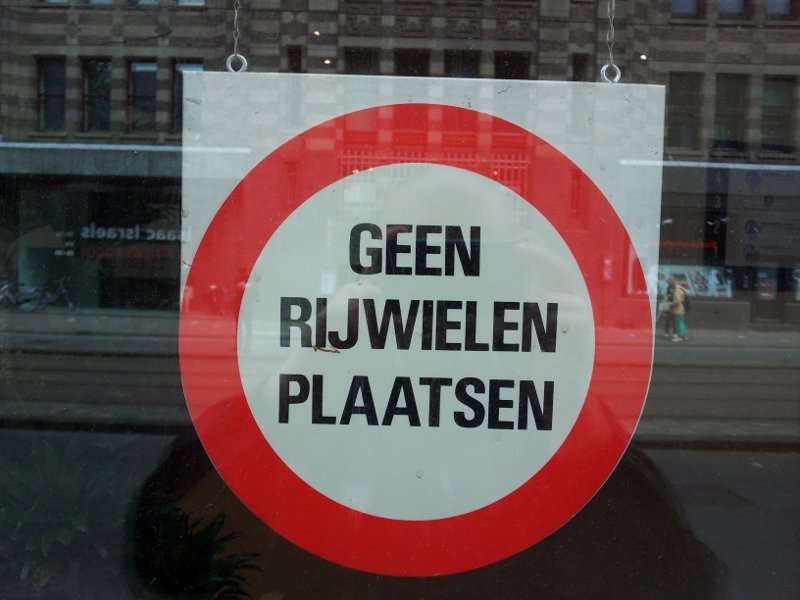
I noticed that two words for “bicycle” are used on the signs in the streets of the Netherlands. One is fiets and the other is rijwiel:

U kunt uw (brom)fiets stallen aan de overkant of rechts om de hoek. (Brom)fietsen worden verwijderd.

U kunt uw (brom)fiets stallen aan de overkant of rechts om de hoek.
(Brom)fietsen worden verwijderd.

Geen rijwielen plaatsen - No placing for bicycles

Geen rijwielen plaatsen – No placing for bicycles

I wonder what the difference is. There’s a Wikipedia article about “fiets”. If I look for “rijwiel”, I get redirected to the same article about “fiets”. My knowledge is not enough to get through the article, but according to what I could get the word “rijwiel” should no longer be in use.

I should get back to this article later, maybe after I am done with
Di3m.

Adding a few words from the article to my vocabulary:

de wetgeving – legislation
kennen, kende, gekend – to know, to be acquainted with
de hulp – help, assistance
terwijl – while, whereas
nooit – never, certainly not
behalve – except, besides, in addition to
dan – then, than

U kunt uw (brom)fiets stallen aan de overkant of rechts om de hoek. (Brom)fietsen worden verwijderd.

U kunt uw (brom)fiets stallen aan de overkant of rechts om de hoek.
(Brom)fietsen worden verwijderd.

U kunt uw (brom)fiets stallen aan de overkant of rechts om de hoek.
(Brom)fietsen worden verwijderd.


U kunt uw (brom)fiets stallen aan de overkant of rechts om de hoek.

1. You can store your moped/bicycle on the opposite side of the street or right around the corner.

2. You can store your moped/bicycle on the opposite side of the street or to the right from the corner.

I am not quite sure if 1. or 2. is correct.


overkant – other side, opposite side (e.g. of a street)
de bromfiets – moped
de fiets – bicycle
het brom – buzz
stallen – store, to garage, put up/away


(Brom)fietsen worden verwijderd.

Mopeds/bicycles will be removed
verwijderen – to remove