-s is appended to an adjective in case if it goes right after one of these words:
iets, niet, veel, weinig, wat
Heb je iets moois gekocht? — Have you bought something pretty?
Niets nieuws — Nothing new.
-s is appended to an adjective in case if it goes right after one of these words:
iets, niet, veel, weinig, wat
Heb je iets moois gekocht? — Have you bought something pretty?
Niets nieuws — Nothing new.
There are four of them: kunnen (can), moeten (must), mogen (may), willen (want)
They all are irregular and I should learn all the forms by heart.
kunnen (can, be able to, be possible to. P.p: gekund)
| ik kan | wij kunnen |
| jij kan/kunt | jullie kunnen |
| u kan/kunt | u kan/kunt |
| hij kan | zij kunnen |
Both jij kan and jij kunt are used frequently.
When inverted: jij kunt → kun jij
moeten (must, have to. P.p: gemoeten)
| ik moet | wij moeten |
| jij moet | jullie moeten |
| u moet | u moet |
| hij moet | zij moeten |
The jij form does not change when inverted!
Ik moet gaan — I must go.
Moet ik naar school gaan? — Do I have to go to school?
mogen (mayb, be allowed to. P.p.: gemogen)
| ik mag | wij mogen |
| jij mag | jullie mogen |
| u mag | u mag |
| hij mag | zij mogen |
willen (want. P.p: gewild)
| ik wil | wij willen |
| jij wilt | jullie willen |
| u wilt | u wilt |
| hij wil | zij willen |
The jij form drops the ending -t when inverted: wil jij?
Hij kan het goed. — “do” is implied — He can do it well
Ik moet wel. — I must, I have got to.
Wij willen het wel. — We want to (do it).
Kunnen, moeten and mogen have the following impersonal construction: het/dat + verb:
Dat kan. — That is possible, that can be done.
Het moet. — It must be done.
Dat mag. — It’s allowed. Or it can also be translated as “you may”.
Here’s an excerpt from dutchgrammar.com (click the link for more useful information on auxiliary and modal verbs): “A verb that is not an auxiliary verb, is called an independent verb. In general, a phrase has exactly one independent verb. This verb is used to specify the action of the sentence. If there are any other verbs, those are auxiliary verbs. These verbs are used to indicate when or how the specified action takes place (presently, in the future, voluntarily, compulsory, possibly, etc.).”
The past participle of a modal verb occurs only if a verb is used independently:
Hij heeft het niet gekund. — He couldn’t.
Ik heb het niet gemoeten. — I didn’t have to.
Wij hebben het gemogen. — We were allowed to.
Zij heeft het niet gewild. — She didn’t want to.
Gemoeten and gemogen aren’t used very often.
When a modal verb is used together with another verb, the modal verb agrees with the subject, while another verb is always an infinitive:
Zij kunnen morgen niet komen.
Zij moet vanavond vroeg naar huis gaan.
U mag hier niet roken.
Ik wil met de auto gaan.
The modal verb is always second item in a sentence, and the infinitive is always the last one.
To ask a question the subject and the modal verb should be swapped. The infinitive should be left where it was:
Moet zij vanavond vroeg naar huis gaan?
Kunnen jullie morgen naar mijn huis komen?
If the perfect tense of a modal verb is needed, while used together with another verb, the past participle of the modal verb is replaced by the infinitive. Now the perfect tense auxiliary verb hebben takes the second position and agrees with the subject:
Ik heb gisteren kunnen komen. — I was able to come yesterday.
Dat heeft zij altijd willen doen. — She has always wanted to do that.
The modal verb (the infinitive) now occupies the position right before the infinitive, which goes last.
To make a question hebben and the subject should be swapped, but the two infinitives in the end remain intact:
Heeft zij dat altijd willen doen? — Has she always wanted to do that?
Het leven passeert als zand door een zandloper.
Life passes by like sand through an hourglass.
de zandloper – hourglass
het zand – sand
lopen – to go, to walk
passeren – to pass
vroeg – early
als het ware – as it were
het avondeten – evening meal
beginnen (is begonnen) – to begin (has begun)
beslist – definitely
bovendien – moreover (what is more)
de coupe – compartment
de dame – lady
het diner – dinner
de eenpersoonskamer – single room
enig – only (single)
het hotel – hotel
lukken (is gelukt) – succeed (has succeeded)
het lukt mij – I succeed
met z’n tweeen – the two of us (you, them)
niemand – no-one
niemand anders – no-one else
onder de twee jaar – under two (years of age)
onredelijk – unreasonable
de receptionist – receptionist
serveren – to serve
de sleutel – key
het spijt mij – I am sorry
de streek – region, district
de tweepersoonskamer – double room
waar – true
achterin – at(in) the back
afhalen – to collect, to meet
de baan – job
dichtdoen (transitive) – to shut
dichtgaan (intransitive) – to shut
gastvrij – hospitable
de jaren negentig – the nineties
de kennis – friend, acquaintance
het huwelijk – marriage
instappen – to get in
meerijden – to have a lift
nergens – nowhere
opendoen (transitive) – to open
opengaan (intransitive) – to open
het portier – door of a car
de studie – studies
de studievriend – college friend
terugkomen – come back, return
zich terugtrekken – to withdraw, to retire
terugzien – to see again
de vakantie – holidays
het vliegtuig – plane
het vliegveld – airport
het voorstel – proposal
elkaar – each other, one another
het vuil – rubbish
meedoen – join (in), take part (in)
aanvaren – to run into
toevallig – accidental
ontmoeting – encounter
namelijk – namely
steeds – constantly (always)
The diminutives are fromed by adding a suffix like -je
Some diminutives have a distinct meaning, which is different than the meaning of the initial form.
het brood (bread) → het broodje (bread roll)
de telefoon (phone) → het telefoontje (phone call)
All the diminutives have het as their definitive article.
Now the hard part about the diminutives: there are quite a few different suffixes to form the diminutives. Each suffix is used in a particular case. So here are the cases:
1. If a noun ends in a voiceless consonant -je is added:
het brood → het broodje
het huis → het huisje
de kop → het kopje
het stuk→ het stukje
de poes→ het poesje
2a. If a noun ends in a vowel -tje is added (a, o, u are doubled):
de koe (cow) → het koetje
de sla → het slaatje
2b. or in a diphthong:
de rij (row, queue) → het rijtje
de trui (jumper) → het truitje
2c. or when a noun ends in -l, -n or -r, preceded by a long vowel, diphthong or a weak vowel:
het paar → het paartje
de tafel → het tafeltje
de trein → het treintje
3. Short vowel + -l, -m, -n, -r or -ng results in -etje
The final consonant always doubles except in case of -ng:
bal → het balletje
de kam (comb) → het kammetje
de man → het mannetje
de ster (star) → het sterretje
de ring → het ringetje
4. -pje:
long vowel + -m: boom → boompje
diphthong + -m: rijm → rijmpje
weak vowel + -m: bodem → bodempje
l or r + -m:
film → het filmpje
arm → het armpje
5. In a nouns ends in -ing and the syllable before the last is stressed, then -kje is added and g is removed from the spelling:
de woning (flat) → het woninkje
het geschenk = het cadeau
schenken – to donate, to give
de wijsheid – wisdom (plural: wijsheden)
verzamelen – to collect, to gather
de uitgeverij – publishing house
de vormgeving – design, styling
de dwaas – fool, idiot
dwaas – foolish, stupid
verkeerd – wrong
de persoonlijkheid – personality, character
de weelde – wealth
prijs stellen op – to appreciate ( “put price on”)
gelukkig – 1. happy 2. lucky
gek – crazy
tussen – between
de daad – deed, action
vermoorden – to murder
de moord – murder
zin hebben – to feel like
het kerkhof – graveyard, church yard
het milieu – environment
bestaan – to exist
het bestaan – existence
de rol – role
vrijwel – nearly, almost (dat is vrijwel hetzelfde – that’s nearly/almost the same)
overnemen – to take over
haalbaar – feasible, achievable
denkbaar – thinkable, imaginable
afschaffen – to abolish
gij – thou (an old form of “you”)
de grondwet – constitution
het heden – present, nowadays, today
huidig – present, current
keren – to turn
afkeren – turn away
langzaam – slow (“longsome”)
de oppervlakte – surface
het ding – thing, object, matter
het genot – enjoyment, pleasure
werkelijk – real, true
de schoonheid – beauty
de kunstenaar – artist
voorbereiden – prepare, get ready
het gerecht – 1. dish 2. court (of justice)
de noedels – noodles
de rijstnoedels – rice noodles
breed – wide, broad
luid – loud
verwarren – confuse, tangle up
zuiver – pure, clear, correct
waardeloos – worthless
verwaarlozen – to neglect (not to take care of)
zelden – seldom, rarely
de fout – mistake, fault, error, flaw
de moeite – effort, trouble
het besluit – decision, conclusion
de dichter – poet
het gedicht – poem
dichten – to rhyme, to write poetry
alles prima – everything’s fine
worstelen – 1. struggle 2. wrestle
zonder – without
Het is ongeveer vijftien minuten met de bus.
ongeveer – about, around, roughly
Misschien kunnen we volgende keer bij de school afspreken?
In het weekend heb ik me een vriend afgesproken.
nabij – near, close (to)
de instuif – housewarming party
de grap – prank, joke
grappig – funny, amusing
het grappige – the funny thing (Het grappige is dat … — The funny thing is that …)
Voor de rest heb ik het weekend overleefd op thee en koffie.
overleven – survive
“Zaterdag echter werd er veel wodka gedronken op het feestje.”
“Zaterdag daarentegen werd er veel wodka gedronken op het feestje.”
echter – however
daarentegen – on the other hand
Laten we dan verder gaan met de les.
Alleen een paar nieuwe woorden.
Ik neem iets om te drinken.
Ik heb een alcoholvrij bier genomen.
Ik voel me vandaag beter.
Ik denk dat ik gewoon een verkoudheid had. TODO: check the word order, it seems to be wrong.
There are two words for “joke” in Dutch that I know so far: 1. de mop 2. de grap
A Dutch-speaking friend of mine explained the difference:
de mop is a verbal joke.
de grap means a prank or an action joke, but might be a verbal joke as well.
It’s been a while since the last post. I am a bit stuck with the 7-th unit of Di3M book. I guess I am already one week behind the schedule by now. This is no good, but I hope I’ll get back to it soon. However, in the meantime and with a help of a Dutch-speaking friend, I started reading a tiny pocket-book of quotes: “Honderd Bekende Nederlanders – hun beste quotes en wijsheden” — “A hundred well-known Dutchmen — their best quotes and wisdoms”.
The book consists of the quotes which are not too long and not related to each other:
“De kunst van te leven is thuis te zijn alsof men op reis is.” — Godfried Bomans
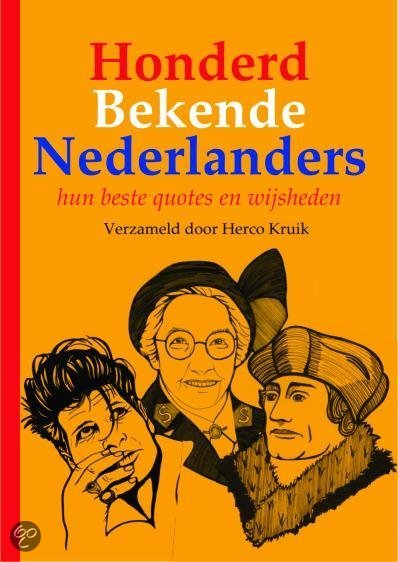
Honderd Bekende Nederlanders – hun beste quotes en wijsheden
De scheur in de blouse werd vakkundig met naald en draad hersteld.
The tear in the blouse was skillfully repaired with needle and thread.
de scheur – tear, crack
vakkundig – competently, with great skill (skilled, competent)
de naald – needle
herstellen – repair, recover
 ::Keep in Dutch::